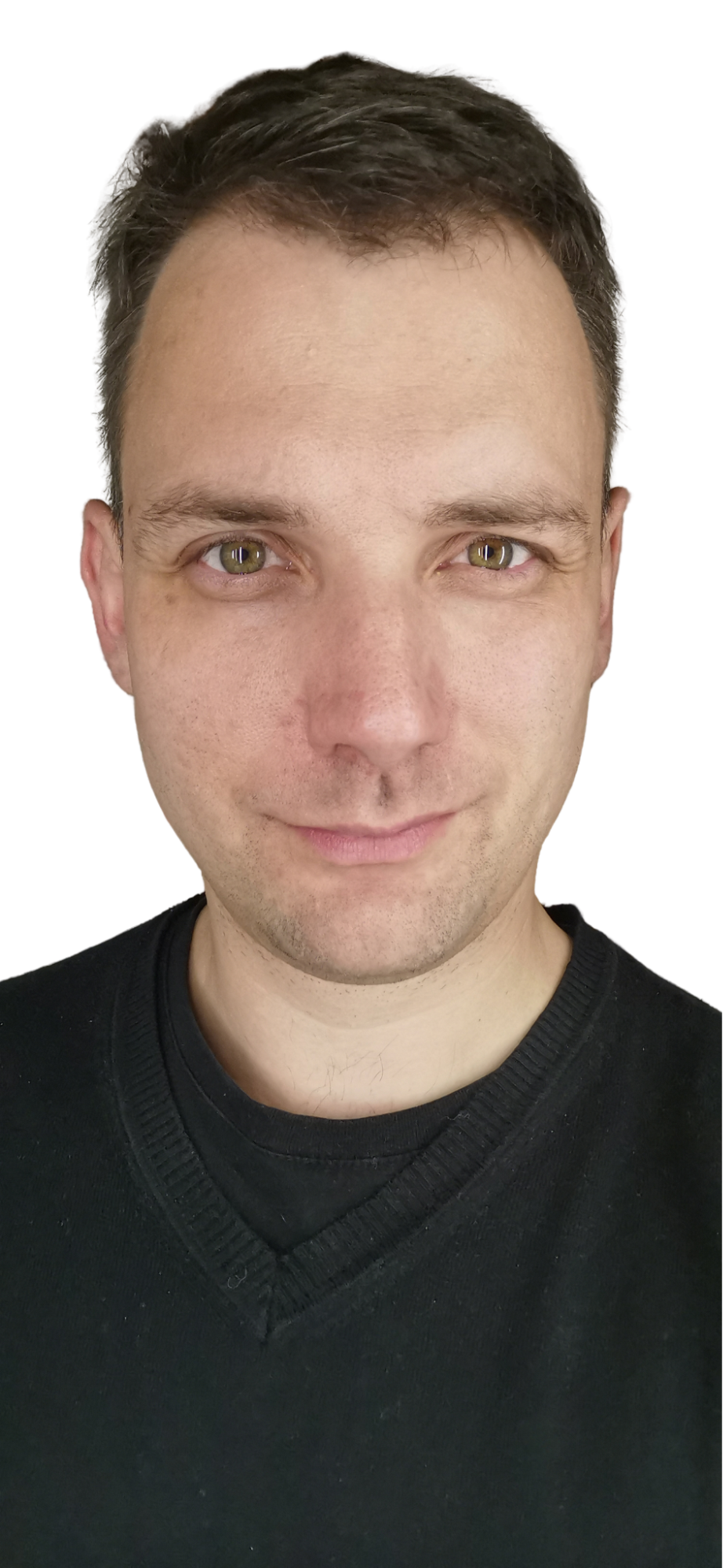




Introduction
What is my greatest strength?
Driven by innate curiosity and a commitment to lifelong learning, I view every professional challenge as an opportunity to expand my capabilities. I am fearless in tackling complex tasks that require venturing into unknown territory to broaden my horizons. However, my approach is grounded in pragmatism. I combine this bold exploration with a hands-on mindset and a strong intuition for prioritization, ensuring I always focus my energy on initiatives that deliver tangible value and high impact.
What are my weaknesses?
When reflecting on my weaknesses, I have a tendency to invest myself too deeply, often more than is necessary. While my passion and enthusiasm are strengths, they can also be a double-edged sword, leading me to take on too much or become overly invested in a project or task. This is also why I am actively working on finding balance through self-reflection and feedback from others.
Professional Experience
CFEngineering GmbH / Head of Analysis and Simulation
I am currently working at CFEngineering as head of the analysis and simulation department, being responsible for a team of 10 people.
In the company I developed all of our automated analysis tools in different programming languages (mostly Python / Java). I am also running a Proxmox server with a few web services for our company. The whole IT system is set up in a professional way from versioning to CI/CD up to deployment with Docker. This allowed us a tremendous productivity increase in both the design and analysis departments and increased ROI respectively.
While our core business is engineering, I involve myself heavily in developing software tools to speed up simulation computations and interpretations, interfacing software systems or automating the general development process. Software engineering has allowed me to perform my tasks as Head of Analysis better, as I can assist my colleagues to get their job done faster and with fewer errors. I am an early adopter of Cursor and use AI in my everyday workflow to automate my development process. The possibilities to improve core company processes seem endless and leveraging AI helps me tremendously. I am very familiar with getting rough prototypes in a short time as proof of concepts to find opportunities. One current example for such a prototype is a license monitor and job queuing server with output log streaming which makes sure our engineers don't have to remote into the server as much as before.
Technical Projects
- Technical / Management Lead for a group of 10 engineers
- Developing optimization software for our engineering department (automated fatigue test scaling optimization)
- Developing software tools for the design department (automatic product tree generation out of the CAD data, pdf attachment macros)
- Developing business analytical tools for the CEO of the company
- Developing software tools for automated knowledge extraction and results presentation for the analysis and simulation group
- Managing roles both internally and externally towards the customer
- Solo projects on multiple smaller calculation projects
- Introducing Basecamp for our whole company to better manage the team, setting up company processes for e.g. concessions
RWU University / PhD Student Simulation Data Analysis
As a PhD candidate at RWU, I centered my research on utilizing graph-based design languages as the foundation for a fully automated engineering design process. I utilized the underlying abstract graph model as a central integration layer to build specific interfaces with a diverse array of software systems. Within this framework, I integrated physics-based algorithms and machine learning techniques – specifically clustering – to detect geometrical structures in topology optimization results. I further validated these modern product design systems by building functional prototypes for diverse use cases.
Institute for Aircraft Design / Master Thesis
The master thesis was about the crack propagation calculation (numerically) in composite structures using Abaqus and the VCCT method. It led me to a better understanding of different automation techniques and finite element preprocessors. Additionally, it was the start of my YouTube channel as I provided some tutorials for applying the method for students of the University of Stuttgart.
Institute for Lightweight Structures / Bachelor Thesis
For my bachelor thesis I decided to do it at the university of Ravensburg-Weingarten. Together with a PhD candidate I could research different bionic adhesion methods and their numerical calculations.
Liebherr Aerospace GmbH / Practical Semester
During my practical semester I was given the task of evaluating topology optimization and its use case for a lever structure assembly for the landing gear doors of a commercial airplane. The task was deriving a lightweight structure from the optimization results. It was the first time I had stepped in the domain of computational mechanics / numerical simulation / optimization and had a great influence on me later on with my PhD.
Education
Dr.-Ing (cum laude) / University of Wuppertal
Development of physics-based solutions for recognition of geometry from structural optimization processes with machine learning algorithms and integrating this in a completely automated process. I used graph-based design languages for implementing this process. Besides not being a predominant topic in the thesis itself, I could dive deeper in the broad topic of knowledge-based engineering, graph representations and transformations (rule-based).
Master of Science (1.3) / Ravensburg Weingarten University
Master of Science in Mechanical Engineering with the specialization in programming, structural mechanics and digital product development.
Bachelor of Science (1.8) / Ravensburg Weingarten University
Bachelor of Science in Mechanical Engineering.
Programming Languages & Technologies
Previous Knowledge
As I am pretty familiar with Java I thought it might not hurt to dip my toes into Windows interpretation of Java. I have not touched it much in a few years.
I stepped into another language to improve my understanding and ability to provide solutions for my colleagues. The much easier way to extract executables led me to Go.
Current Stack
Whenever I have to do some prototyping or something quick, Python is my first choice as it's compact without much overhead and very flexible.
I did much of the coding during my PhD in Java due to a software dependency in the project we committed to work with. I came to like the OO nature of it and it's still a big part of my coding today.
Scripts are operating glue. I have been using scripts continuously over the last years to automate tasks or connect processes.
For interfacing different finite element preprocessors I tend to use TCL quite a bit. Not very much because I chose it but because the interface required me to.
Resources & Community
Tea'n Tech
A YouTube and Discord channel for learning coding
- GitHub Organization
- Chia-Tea (a crypto farm monitoring tool)
- Professional-Python (wip) - course material for a free python course
YouTube Channel
YouTube for Finite Element Method Application as well as some Coding
- YouTube Channel (176 videos)
Publications and Presentations
Awards
Side Activities
Languages
| German | native |
| English | fluent |
| French | basic |